


Olathe Unveils Chiefs Practice Facility Site Ahead of Vote
 January 31, 2026
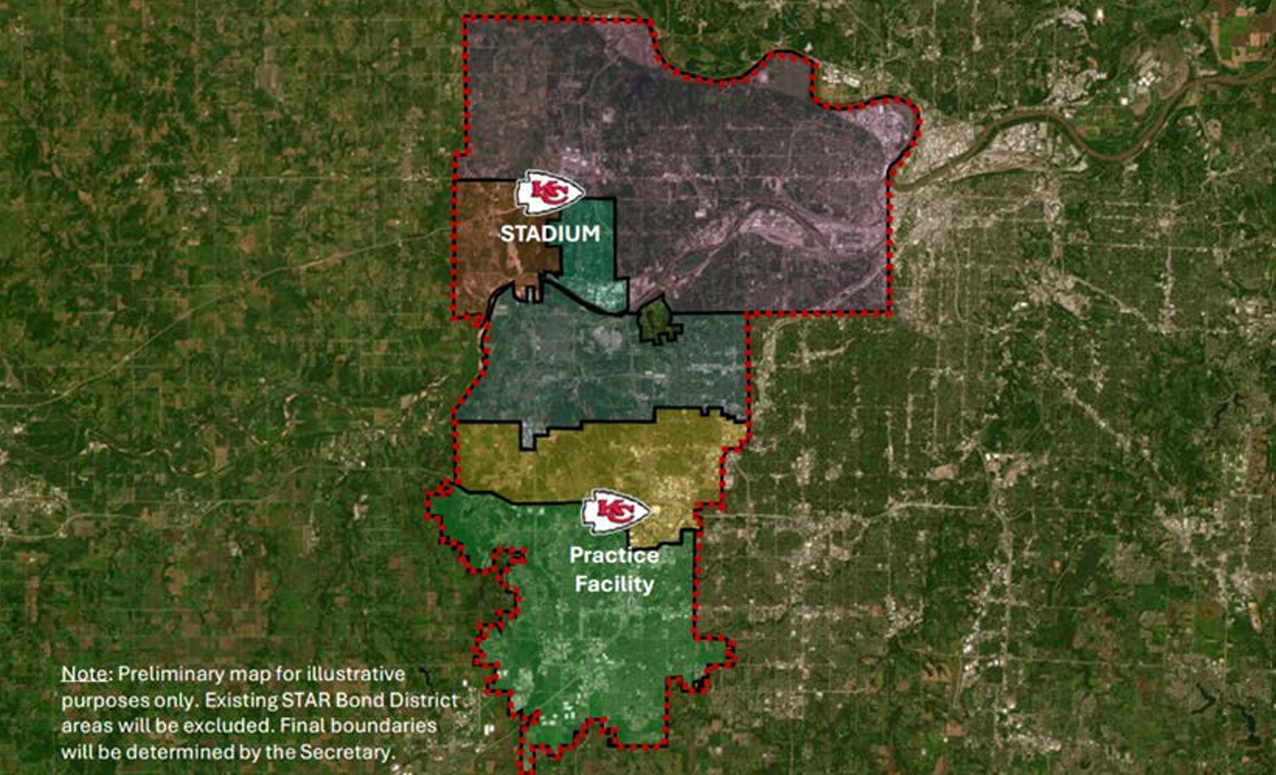
Olathe City Council Considers Tax Pledge for New Kansas City Chiefs Training Facility
The public is getting a first look at where a new Kansas City Chiefs training facility could be built in Olathe, as the city council is set to consider whether to pledge local tax dollars toward the project next week. The Olathe City Council will hold a meeting to discuss allocating local sales and use taxes within a specific area to help repay STAR bonds issued for a Chiefs stadium in Wyandotte County and a training facility in Olathe.
After the announcement of the Chiefs moving across state lines in December, Olathe was given 60 days to conduct a public hearing, vote, and adopt an ordinance that would pledge all new incremental general sales tax generated within the Sales Tax and Revenue, or STAR bonds program area, to the project.
An agenda for the city council’s Feb. 3 meeting shows that public hearing will take place shortly after the regular meeting starts at 7 p.m. According to Olathe Mayor John Bacon, this development provides potential benefits for the city, both in the immediate area of where it’s being developed and beyond.
Proposed Ordinance Details
According to the proposed ordinance, officials are exploring a site for a new Chiefs headquarters and practice facility that’s approximately 165 acres big at the northwest corner of College Boulevard and Ridgeview Road, just south of Kansas Highway 10. The ordinance describes how local tax revenue generated within that project area would be allocated to repayment of the STAR bonds.
STAR Bonds are designed to fund regional attractions by paying back developers with future sales tax revenue generated by tourists. Kansas passed legislation authorizing the state to potentially issue STAR bonds to pay for up to 70% of the cost of the stadium and practice facility and would be repaid over 30 years.
The proposed training facility site is a mostly undeveloped area, bordered to the north by the Garmin Olathe Soccer complex and Ridgeview Marketplace neighborhood. On the east sits a John Deere Ag Marketing building and a handful of other businesses. To the south and west there are apartments, homes, and the Northwood Trails Access Park, where trails snake along Mill Creek.
Under the proposed ordinance, Olathe’s portion of current and existing sales taxes outside of the project area would not be used for repayment of the STAR bonds for the new Chiefs practice facility. This means the city would not divert local tax revenue from the whole city, just from the proposed 165-acre base area.
Key Provisions of the Ordinance
The proposed ordinance would pledge:
- For a period of up to 30 years, all of the City’s general sales and use tax that is not committed to other uses by election of voters or pledged to bond repayment (currently 1%) from within the Base Revenue Area.
- For a period of up to 30 years, all of the City’s share (currently 17.63%) of the Johnson County sales tax that is not committed to other uses by election of voters or pledged to bond repayment (currently 0.5%) from within the Base Revenue Area.
- For a period of up to 30 years, 7% of the City’s current 9% transient guest taxes (less any State administrative fees) with respect to sleeping accommodations in any hotel, motel, or tourist court located within the Base Revenue Area.
The ordinance excludes its street maintenance sales tax, park sales tax, and other retail and compensating use taxes that are committed to other uses by voters. It also excludes any sales taxes generated by existing or future special taxing districts (community improvement districts, tax increment financing districts or transportation development districts).
Also excluded are incremental transient guest tax revenues produced from a levy exceeding 7% not already pledged within any existing tax increment financing districts, and all revenue produced outside of the base revenue area.
The ordinance also states that, “No full faith and credit bonds will be issued by the City to pay the costs of the STAR Bond Project.” In no event will the Bonds be deemed to constitute a debt or liability of the City, and the issuance of the Bonds will not obligate the City to levy any form of taxation or to budget or make any appropriation for repayment of the Bonds,” the proposed ordinance states.
Olathe City Councilwoman LeEtta Felter said in a social media post Saturday that the project could increase Olathe’s tax base. “As always, the goal of any development is to make Olathe more prosperous now and into the future,” Felter said. Felter also said in a phone call Saturday that she is excited about what the development could mean for the future of Olathe.
Focus on Local Sales Taxes
Olathe’s ordinance focuses on diverting local sales taxes to the Chiefs project – not state sales taxes. Olathe is already included in the proposed massive STAR bond district to pay back the bond amount over several decades. Since the state gets to set the terms of and approve the deal without local signoff, the law only authorizes it to pledge state – not local – sales tax money to pay back the bonds. However, the law says that local governments can choose to divert their local sales tax revenue to the stadium bonds too, which is what Olathe will discuss Tuesday.
The preliminary district that state officials proposed for the Chiefs’ bond district extends well beyond the immediate area surrounding a stadium. It stretches across nearly all of Wyandotte County and most of western Johnson County. That means new state sales tax money throughout that entire area would be put toward paying back stadium debt instead of other government priorities for 30 years.
How to Participate in Public Hearing
Residents wanting to speak at the Olathe meeting are asked to sign up beforehand. They can sign up by calling the city clerk’s office at 913-971-8521 or emailing CCO@OlatheKS.gov by 4:30 p.m. Tuesday. In-person sign-up is available at City Hall until 30 minutes prior to the start of the meeting. Each speaker is allowed up to 5 minutes to address the City Council.