


How the Packers Fought to Stop the Ravens’ Run Game
 January 4, 2026
The Ravens’ Dominant Performance in Green Bay
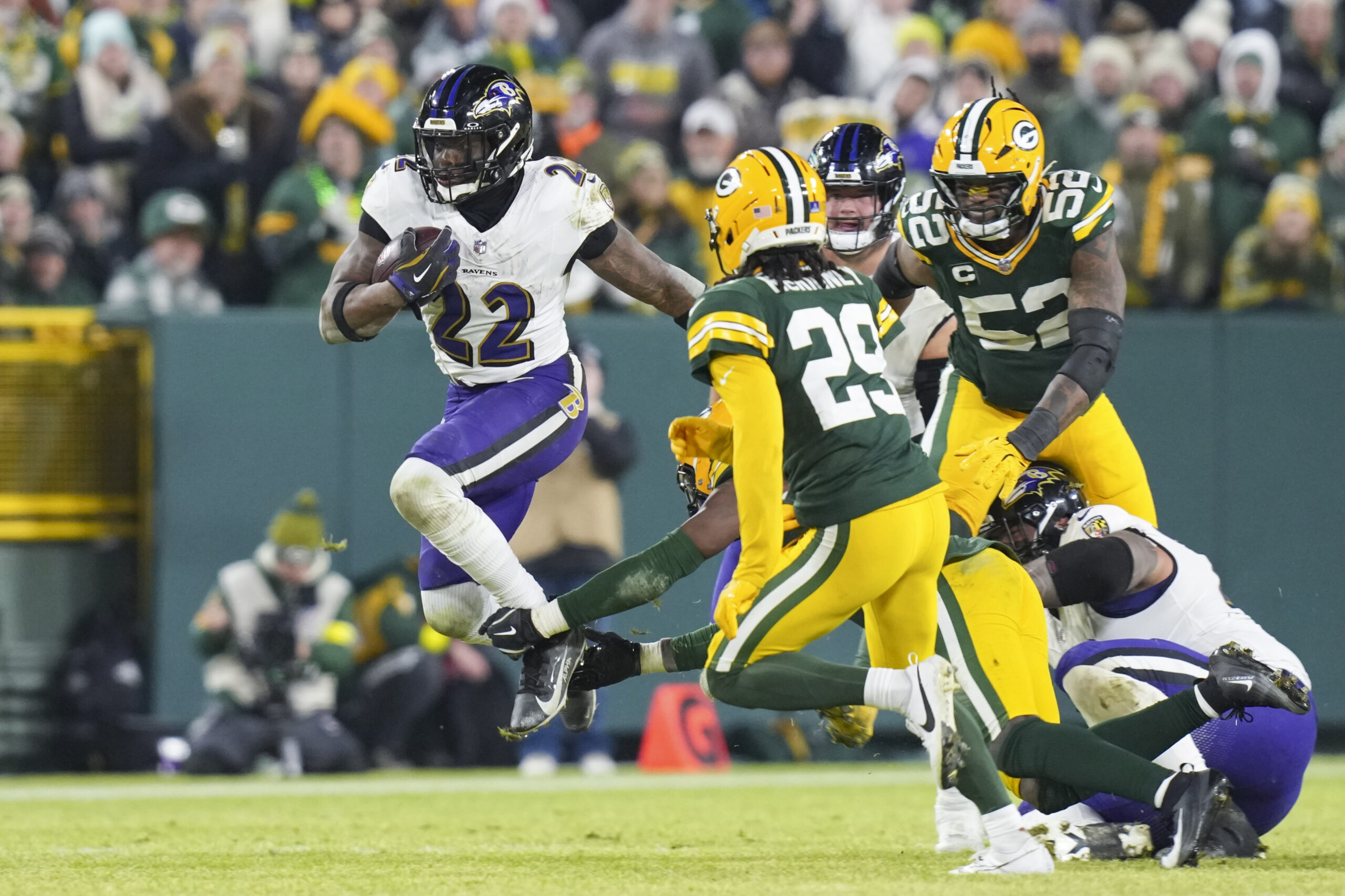
In a thrilling Week 17 matchup, the Baltimore Ravens showcased their offensive prowess by defeating the Green Bay Packers with a decisive 41-24 victory. This win was largely fueled by the exceptional performance of running back Derrick Henry, who amassed an impressive 216 yards on 36 carries and scored four touchdowns. His ability to break through the Packers’ defense was evident, particularly on long runs from 30 and 25 yards out.
The Ravens’ success was not just due to Henry’s individual brilliance but also the effective execution of their running game. They managed to control every level of the Packers’ defense, forcing the secondary to make tackles. This victory can be attributed to a combination of a strong run scheme, the lack of depth in the Packers’ front line, and some mental errors made by the opposing team.
Effective Running Schemes
On early downs, the Ravens primarily utilized a zone running scheme with a lead fullback. This strategy proved successful, as Henry carried the ball 11 times for 63 yards, averaging 5.7 yards per carry and achieving a 72.7% success rate. Success rate is calculated based on the percentage of yards gained relative to the required yards for each down.
The Ravens predominantly featured a two-back weak-side zone running game when this type of run was called. One specific play, known as BOB (Back on Backer), is a weak-side inside zone run designed to isolate and lead up on the weak-side linebacker. The inclusion of the fullback typically provides an extra blocker at the point of attack, giving the offense a +1 advantage in gaps.
Defensive Challenges
During the play, the defense struggled to contain the Ravens’ offensive line. Edgerrin Cooper used a hammer outside technique on the fullback, but there was no one else to provide support inside. Quay Walker, who should have been there, couldn’t get off the block from the center. On the backside, safety Evan Williams ran under the block of the backside guard, which took him out of the play. If he had been able to get over the top, it might have limited Henry’s gain.
The Ravens also executed this play on the strong side, using a stretch/outside zone run with the fullback leading up after taking an outside zone path. This strategic move allowed them to exploit the Packers’ defensive weaknesses effectively.
Strategic Formations
The Ravens employed a balanced 22 personnel formation along the line of scrimmage by motioning the second tight end over to the left. This setup allowed them to create space and opportunities for their running game. The run hit inside the two Packers defenders on the right edge of the defense, where Henry and fullback Pat Ricard found a lane for a nine-yard gain.
Walker was alone on an island and couldn’t get off the block, but the Ravens had five blockers for four defenders, creating a +1 blocking advantage. Even when the Packers condensed their front, the Ravens still managed to reach the edge by pulling defenders out of the box and shifting the blocking numbers to maintain their advantage.
Tactical Adjustments
In another instance, the Ravens sent two receivers to the left with the back to the left of Tyler Huntley and used a motion into a stack. This suggested a run-pass option or zone read with a shield slant off the alignment of the outside linebacker. The defense countered by shading a safety out over the two receiver side and walking the outside linebacker that way.
However, Huntley wasn’t reading any defender, the receivers weren’t looking for a pass post-snap, and the offense didn’t leave anyone unblocked on the backside. The Packers were down a defender in the box 7-to-6, allowing the Ravens to execute a sweep to the right with a man advantage.